Showing posts with label History of Singapore. Show all posts

Thursday, January 19, 2017

The Ancient Histories of Singapore


The earliest possible mention of ancient Singapore is dates back to 2nd Century cartographic references. Greco-Roman astronomer Claudius Ptolemy (AD 100 - AD 170) marked a place called Sabana, a coastal port at the southernmost tip of the Malayan peninsula, on his map. The area where Singapore lies and identified was known as a "Nominon Emporion" or a designated foreign trading port. It was a part of a chain of trading centers that linked South East Asia with India and Mediterranean.
Links between India and Singapore go back to ancient times. In the first century A.D., Claudius Ptolemaeus, a Greek astronomer, collected astronomical observations from the countries around the Indian Ocean in order to determine their locations. One of these, Sabana, lay in the area of modern Singapore.  Sabana was a nominon emporion or designated foreign trading port, part of a chain of such trading centres which linked Southeast Asia with India and the Mediterranean 2,000 years ago.  The Greeks themselves never reached Sabana. According to Ptolemy, Sabana should have lain somewhere in the vicinity of the Johor-Riau-Singapore area.
Source : Records of Ancient Links between India and Singapore
A 3rd century Chinese witten record also described the island of "Pu Luo Zhong" (蒲羅中). This is probably a transliteration of the Malay Pulau Ujong, "island at the end" (of the Malay peninsula). It is said that Pulau Ujong maintained as a fishing village from that time on.

In 1320, the Mongol court has sent a mission to a placed called Long Yamen (Dragon's Tooth Strait) to get elephants. This probably referred to Keppel Harbour.A visitor from China, Wang Dayuan, who came around 1330, called the main settlement Pancur (spring), and reported that there were Chinese already living here.

Sabana on Ptolemy's world map
Sabana on Ptolemy's world map
One of the earliest references to Singapore as Temasek, or Sea Town, was found in the Javanese Nagarakretagama' of 1365. The name was also mentioned in a Vietnamese source at around the same time. By the end of the 14th century, the Sanskrit name, Singapura (Lion City), became commonly used.(Source : Singapore History)

The Sejarah Melayu or Malay Annals contains a tale of a prince Srivijaya, Sri Tri Buana (also known as Sang Nila Utama). During one of his voyages, he saw the beautiful beach of Temasek (Sea Town) and decided to take a closer look. He only reached the Temasek after surviving a great sea storm in the late 13th century. According to the tale, the prince saw a strange creature, which he was told was a lion. Believing that this is an auspicious sign, he decided to name the new settlement Singapura, which means Lion City (lions have never lived in Singapore and the name probably comes from the shape of the island which looks like a male lion with mane on the map).

In late 15th century, Singapore appears in Malay Annals :
The Sejarah Melayu or Malay Annals, compiled around 1435, contains information passed down from earlier times. The first section of the Malay Annals tells the story of a great Indian ruler, Raja Shulan, who after conquering all of India, set his sights on China.  However, he only had a vague idea of where China was.  The Chinese, learning of Raja Shulan's intent, and wishing to avoid conflict, employed a stratagem.  They sent an old ship crewed by a group of aged men to Singapore. Raja Shulan, on his way to China, also stopped in Singapore.  He met the doddering Chinese sailors and asked them how much further away China lay. The old sailors informed Raja Shulan that China was so far away that when they had set out, they were still young. Raja Shulan decided to return to India.
Source : Records of Ancient Links between India and Singapore
Singapore was caught in the struggles between Siam (now Thailand) and the Java-based Majapahit Empire for control over the Malay Peninsula. According to the Sejarah Melayu (Malay Annals), Singapore was defeated in one Majapahit attack, but Iskandar Shah, or Parameswara, a prince of Palembang, later killed the local chieftain and installed himself as the island's new ruler. Shortly after, he was driven out, either by the Siamese or by the Javanese forces of the Majapahit Empire. He fled north to Muar in the Malay Peninsula, where he founded the Malacca Sultanate. Singapore remained an important part of the Malacca Sultanate; it was the fief of the admirals (laksamanas), including the famous Hang Tuah.(Source : Singapore History)


Recent excavations in Fort Canning provide evidence that Singapore was a port of some importance in the 14th century and used for transactions between Malays and Chinese.

Monday, January 2, 2017

The Great Singapore Penis Panic


In 1967, a strange series of events unfolded on the island of Singapore. Hundreds of men rushed to the hospitals of the island with the terrifying belief that their penises were shrinking. Each feared that if his penis shrank away completely, he would die. Some came with lucky red strings tightly wrapped around their penises to prevent the lethal disappearance. Others had clamps holding their wayward organs in place. Most often it was a firm grasp of a hand, their own or a frightened family member’s, that prevented the shrinking penis from slipping away and taking their life with it.

This was "The Great Koro Epidemic of 1967". According to American Psychiatric Association's Diagnostic and Statistical Manual of Mental Disorders, Koro is a culture-specific syndrome delusional disorder in which an individual has an overpowering belief that one's genitalia are retracting and will disappear, despite the lack of any true longstanding changes to the genitals.

Oddly enough, about a dozen women also fell victim to the panic.

This strange penis attack is now recorded in a book : The Great Singapore Penis Panic and the Future of American Mass Hysteria. Available on Amazon. The Great Singapore Penis Panic and the Future of American Mass Hysteria explains the basis of koro in Chinese medicine, and how and why something so peculiar as the Singapore Koro epidemic could have happened when it did.

The Great Singapore Penis Panic

Friday, August 7, 2015

The Violin animation : 80 years of Singapore history in 17 minutes


Have you seen The Violin by Ervin Han? The animation shows the journey of a violin through 80 years of Singapore history starting from 1939, a few years before the horros of Japanese occupation :
"Circa late 1930s, Boat Quay, Singapore. A young boy receives an old violin as a gift out of kindness from a foreign trader. From then on, it becomes a treasured possession as he teaches himself to play the instrument over several years, until it was lost during the Japanese Occupation of Singapore. After the war, the violin was found by a man working for the British Military Administration and given to his young daughter. The girl learns to play it and becomes a renowned violinist over the decades. She eventually passes the instrument on to her grandson, an accomplished violinist himself, who restores it and performs in a concert by the Singapore River, where the violin started its unexpected journey nearly 80 years ago.
Throughout the film, the violin graces different stages of Singapore - both figuratively and literally – as we see a young nation’s landscape evolve from a bustling 1930s to the dark days of the Japanese Occupation, followed by the sweeping political changes that lead to its independence and finally, present day."
It is a very nice animation and it is especially meaningful to watch it in this SG50 weekend.
You can watch this 17 minutes animation below. Make it full screen.


Below is a scene from the animation. It shows 1930s Boat Quay Area.

Monday, August 13, 2012

Singapore's Downtown from past to present


There is an interesting 2 part article named From water to Green site to Skyscraper City in the New Downtown  in Good Morning Yesterday blog which shows how Singapore's downtown changed dramatically since late 70s. A must read!

In the below photo, shot from a plane taking off from Paya Lebar Airport, you can clearly see the landfill in progress. Between 1976 and 1985, hills and elevated plains on current Tampines New Town were leveled and material from this place is used to fill the downtown area (as the hills of Bedok was used for East Coast). Singapore once was not as flat as it is now!

Below, you can clearly see the Marina Bay area landfill (where Marina Bay Sands and Gardens By The Bay stands now). Note that the plot on which Gardens By The Bay sits now does not exist yet. Also on the right hand side, you can see the reclamation in progress for Millenia Walk area.

Singapore Downtown in 1980 -  Source : Good Morning Yesterday

In the photo below, you can see the land reclamation in progress.

Singapore Downtown in 1980s - Source : Good Morning Yesterday
Fast forward to 2002. Actually Just until 3-4 years ago, the site where Marina Bay Sands Casino Complex stands now was a large vacant green area as you can see in the photo below (taken in 2002).

Vacant Area on where Marina Bay Sands Casino Complex is built - Source : Good Morning Yesterday

Below, Marina Bay Sands is under construction:


Marina Bay Sands under construction - Source : icis.com
The area today:

Singapore Downtown

Saturday, July 7, 2012

Visit to Singapore in 1964


The video below is shot by Hans Brinckmann and his wife in 1964 when they have visited Singapore in the course of a cruise by ms Straat Banka through the Far East. It is recorded on Kodachrome 8mm film. It is a quite clear look at what is now Singapore city center without all those land fill and skyscrapers.

At 0:35, you can see the current Fullerton Hotel and the Central Business District on the shore before the landfill.  At 1:04, there is a clear shot of that time's tallest building in Singapore,  former Asia Insurance Building (current Ascott Raffles Place). On the right hand side, you can see the beautiful Ocean Building, which was demolished in 1970 to give way to a 28 storey bulding also named as Ocean building. Currently, that building has also gone and Ocean Financial Centre stands on the land.

The video continues with some color shots of daily life in Singapore in 1964.


Saturday, March 3, 2012

1966 color photo of Raffles Place


I have seen this rare gem, a color photo of Raffles Place taken in 1966/67, in mrbrown.com. Raffles Place can easily be considered as the place where Singapore story started.  The founder of modern Singapore, Sir Stamford Raffles, wanted Singapore to become a "great commercial emporium and at the heart of this dream was Raffles Place.[1] The place was first named Commercial Square but renamed to Raffles Place back in 1850s.

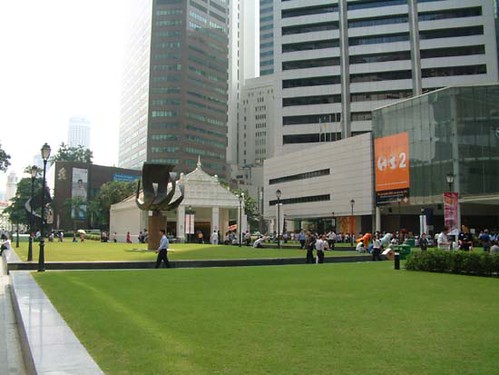
Unfortuntely, the place is currently not as beautiful as it was back in 1966. All the buildings you see in this photo are demolished and Raffles Place is now a sterile, ugly, and a soul-less place squeezed with skyscrapers (see photo below).

Downtown Singapore
Raffles Place 1966/67 - Source : Flickr
SNAP: Singapore National Album of Pictures comments in Flickr gives a brief description of the buildings:

"The old classical Chartered Bank building featured here was designed by Swan & Maclaren. It was replaced in 1982 by a 44-storey rhombic-shaped building now renamed as 6 Battery Road.

The United Overseas Bank [former United Chinese Bank] stood at the corner of Bonham and Chulia street. The old building in the photo was demolished and the construction of a new one started in 1970 and was ready in 1974.

On the John Little site today is Shell Towers, built in 1982. In 1965, the open space in the foreground was excavated to provide for a underground carpark accommodating 250 cars. Above it [as seen in the photo] was a landscaped garden; with two ornamental fountains and 42 lamps that lit the garden by night.
Today, the underground carpark has been converted to the Raffles Place interchange for the MRT [Mass Rapid Transit] trains."

Raffles Place 2012

Friday, September 9, 2011

Feng Shui in Singapore


Many may not realize the importance of feng shui, ancient Chinese system of aesthetics, in Singapore architecture. But there are few buildings or building complexes out there built without consulting a feng shui master. Singapore itself has a feng shui in its foundation, and let's start with it: the belly of the carp.

The belly of the carp

Since the first Chinese settler's came to Singapore in 1800s, the south bank of the Singapore River has been a very auspicious place to do business for Chinese. This side of the Singapore river, known as Boat Quay, was the busiest part of the old Port of Singapore. Boat Quay was handling three quarters of all shipping business during the 1860s. Why it was so auspicious? The south of the Singapore river in Boat Quay resembles the belly of a carp. According to Feng Shui, this is where wealth and prosperity lay and this is the main reason many shophouses were built and crowded into the area.

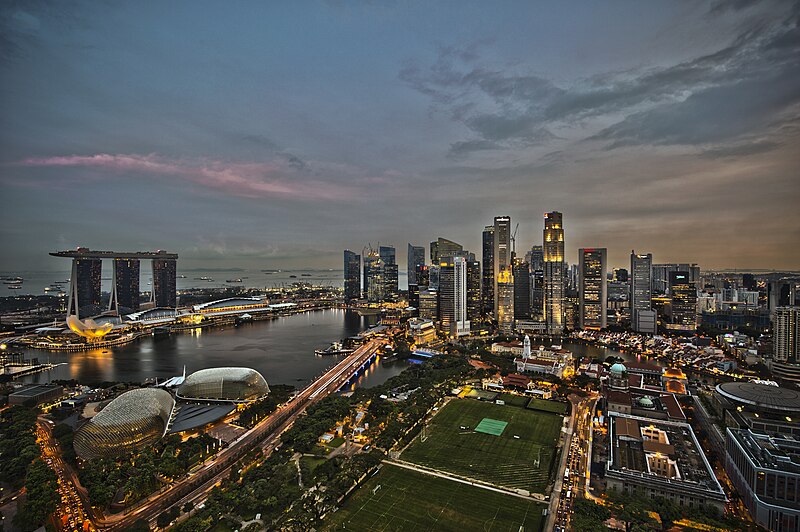
In the below photo, you can see how prosperous Singapore Cental Business District is rising from "the belly of the carb" (water body below the skyscrapers is Singapore river). Great Feng Shui example!

Singapore skyline
Fountain of Wealth


Fountain of Wealth, the largest fountain in the world, is another example of Feng Shui in Singapore. This fountain and the surrounding buildings of Suntec City are built Feng Shui in mind.

Water flows inward in this fountain. It may look weird to you but in Chinese culture, water is the symbol of life and wealth and the inward motion of the water, according to feng shui experts, represents riches pouring in. Remember This is the reason they named it as "Fountain of Wealth".

But feng shui does not stop there. The buildings of Suntec City looks like the fingers of a hand opened to the sky. Fountain of Wealth looks like a bronze ring in the palm. So the water flowing inwards also represents wealth pouring palm!

It is also said that, if you walk around the central base of the Fountain of Wealth three times while touching the water at all times, you would gain some good luck of your own.

Fountain of Wealth
Marina Bay Sands IR
There is no consensus on the feng shui of Marina Bay Sands IR buildings. Some say it is bad and caused financial problems for parent Las Vegas Sands during its construction and some says it is good. You can read a debate on it here in Feng Shui: Marina Bay Sands IR. An interesting comment comes from a feng shui master:

"Master Tan Khoon Yong of Way Onnet Group said it resembles a blade that will affect (cut) all buildings surrounding the IR, especially the Swissotel Stamford. "Also, because the rooftop is flat, it restricts the development and growth for the IR," he said."


The Gateway 
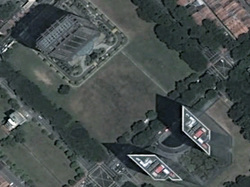
There is no way to not recognize the four weird thing next to Bugis Junction: The art deco style Parkview Square which looks like a building transported from Gotham City to Singapore accidentally, 2 sharp edge buildings of The Gateway and a large empty land sitting idle between those despite its excellent location for development. It is rumored that no Singaporean developer is showing interest to this site because of the bad feng shui caused by the sharp edges of The Gateway buildings. For the same reason, you can expect the sites on the other sharp edges of The Gateway Buildings to stay idle for a long time, despite their close proximity to Nicoll  Highway MRT Station.

The Gateway Buildings and large empty plot between them
and Parkview Square
Wheelock Place

Another structure as a bad feng shui in Singapore is Wheelock Place. As you know, famous bookstore Borders has gone out of business there. This is not the first unlucky event in the building. The building itself was completed in 1994 but closed down during 1990s due to Asian Financial Crisis. In article named "Five Elements of Orchard Road Buildings" another unlucky event is depicted:

"Wheelock building was invested by a group of financier from Hong Kong. It was built like a shape of a harp, to signify a continuous progress. It's concourse sits on Hai and facing Si. The Building was erected during the Age of 7th, thus resulting in Up mountain and Below water formation?. It's pointed entrance at the concourse is at Zhen Flying Star 64 which does not signify wealth. Inflow of water at Ping Flying Star 31, outflow of water at Chou Flying Star is 29. This does not fit the requirement of the theory, which demand a lucky inflow and unlucky outflow directions.

Thus within a short span of nine months, Lane Crawford Department Store has sized down their operations from five floors to two floor and ceased business later. This was due to financial problems."
Source: Five elements of orchard road buildings

Saturday, July 2, 2011

Singapore, Unseen/Unsaid


RediscoverSG team, 4 third-year students from Wee Kim Wee School of Communication, prepared a 10 part mini-series named "Unseen/Unsaid". They have talked with older generation of Singapore and tell us their forgotten stories in these 10 short videos.

"The lady in the Chinese opera video - she's an old Chinese grandmother who speaks Cantonese. She's from Hong Kong. She speaks traditional Cantonese, not street Cantonese" says Elizabeth Lee, on of the members of RediscoverSG. "We did not expect the older generation of Singaporeans would be willing to talk to us" she said. "You realize a lot of them have stories, but nobody has ever bothered to ask them. Once you ask them, they are willing to tell."

She says "growing up in Singapore we have seen a lot of things and used to think that they will be a part of landscape forever. But when we have grown older we have seen that a lot of things we have taken granted are disappearing from the landscape. So we have just wanted to capture whatever we can capture before they really disappear."


A traditional bakery, a glimpse of what lies behind the curtains of a Chinese street opera, an old playground sitting uncomfortable amid new developments. These are some of the videos they have prepares in 6 months and with $100,000 ($75,000 of it is a grant from National Heritage Board).  You can follow them from their web page rediscoversg.

Thursday, March 24, 2011

Coolies


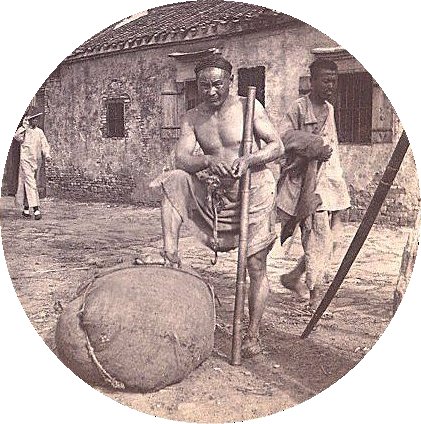
The term "coolie" is probably of Indian origin and is thought to be derived from the Hindi word "quli" which means "hired labourer". Coolies were labourers imported into various colonies in the Americas, Africa, and Asia during the 19th and 20th centuries. Most of them were recruited under indenture, though some entered the colonies as free men.

Periodic poor harvest, famines, increased stress on agricultural land and political upheavals are some of the factors which drove people from places such as China and India to the colonies which needed vast number of manual labourers.

The key ports from which coolies were shipped abroad included Xiamen, Shantou, Hong Kong, Macau, and Nagapatnam. The journeys made by the coolies to Singapore were terrifying. The coolies were herded across the sea confined in crowded, squalid, and unsanitary conditions. Hundreds died on the journey. On one junk that arrived in Singapore from Macau in 1863, only 120 of its 300 passangers were still alive.

By late 19th century, Singapore had become the center of the import of Chinese coolies to work in mines, plantations and ports of colonial South East Asia. Coolies were also retained to work in Singapore. Indians and Javanese also joined the vast number of Chinese coolies in Singapore. The coolies heaved coal, carried goods, tapped rubber, worked on plantations, worked on lighters, ladi cables and tracks for trams, built and repaired roads, and were also involved in construction and reclamation projects. Many also worked as ricksaw pullers.

With some exceptions, coolid led bitterly hard lives. Retiring to cramped living quarters after toiling hard work, several sought relief in opium smoking. Many stayed on after serving out their indentures and pald up the debts owed to their recruiters and labour brokers. Some were cheated of their life savings just before they were due to return to China.

Chinese coolie
Chinese coolie - Source: Wikipedia
The newly arrived coolie recruit was called sin kheh which meant "new arrival" in Hokkien. The secret societies and clan associations were involved in controlling and regulating the immigration of coolies from China. Secret societies would help the peasants pay for their journey to Singapore. Upon arrival, the majority of the early coolies would be handed over to employers of the same dialect, The kongsi, or a "clan association" was either an organisation, a group or a network of like-minded individuals speaking the same dialect or from the same province/part of China. The secret societies therefore acted as agents helping the peasants to come to Singapore, and to find employers from a certain kongsi, depending on the dialect of the particular peasant. Recruitment was carried out based on dialect connections. The secret societies helped support the coolies financially in times of illness, defended their livelihoods and organised final rites. The British however felt threatened by the rising power and prominence of the secret societies, and made these societies illegal in 1890. An official Chinese Protectorate was set up to handle the immigration and official procedures for coolies. Voluntary associations also arose, supporting the coolies in their immigration and transition into Singapore.


Monday, March 21, 2011

Good morning yesterday


It is incredible to look at old Singapore photos and kampong days pictures. You realize how Singapore has changed since 1960s, from kampong days to a first world city state. This change fascinates even the ones who have not been here for a long time, think about the generation who have lived through this great change. How do they feel when they look back the past 30 years? Well actually there is an excellent blog where some of them shares their feelings and memories of the past as well as the photos from past: Good Morning Yesterday.

Good Morning Yesterday is prepared by Lam Chun See who was born in 1952 in Singapore. He says that "this site is for Singaporeans and friends of Singapore of his generation to share stories of Singapore back in the kampong days when we were kids. I started this blog because I realised how much our country has changed in our life time, and it would be good if our kids can visit this site and learn a bit about our past. Please feel free to share your experiences". Younger people will also love this site, because it contains stories from the now extinct past of Singapore, kampong days.

Lam Chun See decided to start his blog when he came back from Myanmar in 2005. On his way back to the airport, he shared the hotel car with a Japanese visitor and during their conversation, he remarked that Yangon was very much like Singapore during the time when he was a kid. Many of the old British style buildings resemble those in Singapore. Japanese visitor was surprised and said that Singapore must have changed a lot during the past few decades.

It indeed changed a lot and too during a life, the physical landscape especially, has changed a lot. He then started this blog to share his memories of life back in the 60' s and 70's when he was a kid.

Kampong Buangkok, last surviving kampong on mainland Singapore
What I like most about Good Morning Yesterday is that great effort is put to detail the stories of the past. The content is just awesome, I sometimes loose my self in it for hours. Just a couple of days ago I met with my Singaporean landlord in his early 60s and shared the blog with him. Stories opened stories and we have lost ourselves in the blog for 2 hours! It was a great emotional experience for him, he does not use internet and did not see most of the old Singapore photos before.

By the way, if you are interested in to see what was life in Singapore in Kampong days, you do not need to head to Pulau Ubin, there is also one surviving kampong on mainland Singapore, Kampong Buangkok.

Monday, February 21, 2011

Raffles' Landing Site


This statue of Sir Stamford Thomas Raffles (1781 - 1826) marks that part of the Singapore river bank where he was said to have first landed on 29 January 1819.

Raffles an agent of the British East India Company, ventured to Singapore hoping to establish a free port and a halfway point for traders along the China-India trade routes. After signing the preliminary treaty with Temenggong Abdul Rahman, the official treaty with Sultan Hussein of Johore-Riau was signed on 6 February 1819, giving the British right to establish a trading port on the island.

The Dutch protested as Singapore was then part of the Dutch Johor-Riau Empire. The dispute was resolved with the signing of the 1824 Anglo-Dutch Treaty, where the British acquired Malacca, Penang and Singapore, while Dutch gained Bencoolen (present day Bengkulu) and the rest of Indonesia. In August 1824, another Treaty of Friendship and Alliance was signed, giving the British the governance of Singapore.

From the 19th Century, Singapore's success as the "Great Emporium of the East" owed much to its free port status and strategic location. The Singapore River became the main artery of the trade, where port, trading and warehouse facilities developed along the river banks.

In 1867, Singapore became a British Crown Colony after the transfer of The Straits Settlements from the British Administration in India to the Colonial Office in London. It remained so until 1959 when Singapore achieved self government.

Wednesday, January 26, 2011

Interesting Facts About Singapore


Below, we have compiled some interesting and sometimes fun facts about Singapore:

1 - Most think Singapore's national language is Chinese or English but it is wrong. Singapore's national language is Malay. English, Malay, Chinese (Mandarin), and Tamil are official languages. The Malay language is used in the national anthem "Majulah Singapura" and printing of coins. Military commands are also given in Malay. However, around 85% of Singaporeans do not speak Malay.

2 - Greek astronomer, Claudius Ptolemaeus, named a place called Sabana in 2nd century, in the area where Singapore lies.  He identified Sabana as a nominon emporion or designated foreign trading port, as part of a chain of similar trading centres that linked Southeast Asia with India and the Mediterranean. 3rd century Chinese written record described the island of Púluōzhōng (蒲羅中), probably a transliteration of the Malay Pulau Ujong, "island at the end" (of the Malay peninsula). This island is thought to be Singapore and this name is one of the earliest references to Singapore. [1]

3 - The south of the Singapore river in Boat Quay resembles the belly of a carp. According to Feng Shui, this is where wealth and prosperity lay and this is the main reason many shop houses and eventually the tall skyscrapers were built and crowded into the area.

4 - The Fountain of Wealth in Suntec City is the largest fountain in the world. The bronze ring of the fountain represents a ring in a left palm of a hand, buildings of the Suntec City representing the fingers. The water flaws downwards representing wealth flowing to the palm of a hand. Yeah, it is Feng Shui.

5 - The Bukit Timah Nature Reserve in Singapore contains more species of trees than the entire North American continent.

Bukit Timah Natural Reserve
Bukit Timah Natural Reserve Source: laurainsingapore

6 - Singapore has its own yeti. The creature said to inhabit Singapore (mainly the forested Bukit Timah region) is called The Bukit Timah Monkey Man. The creature is often cited as a forest-dwelling hominid or primate, and is also accounted for as being immortal; however, its exact identity remains unknown, and its existence disputed. Alleged sightings of the animal are rare and come mainly from Malay folklore, accounts from Japanese soldiers in World War II, and occasional unconfirmed reports from local residents.It is described as hominid-like, greyish in colour, and between one and two meter in height, and bipedal.

7 - Buildings in Singapore cannot be higher than 280 metres. This is due to the proximity of any point in the island to Changi Airport. OUB Centre, UOB Plaza and Republic Plaza are the only buildings in Singapore with that height.

Overseas Union Bank Centre
OUB Center

8 - More Singaporeans are born in the month of October than any other month of the year.

9 - Singapore has a verry interesting man-made landfill island. This island, known as Semakau landfill for now, is made entirely from garbage incinerator ash.

10 - When Thomas Stamford Raffles arrived Singapore in 1819, there was only a small Malay settlement, with a population of a few hundred, at the mouth of the Singapore River. 5 years later in 1824,  the total population was 10,683. The 2000 census showed that the population of Singapore is 4.2 million. It is closed to 5 million by 2010.

Thomas Stamford Raffles

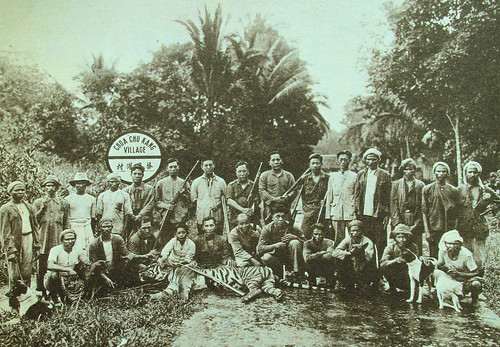
11 - The last wild tiger, roaming Singapore was killed in Choa Chu Kang area, in the 1930s. But these animals were once a significant cause of death in Singapore. By the middle of the 19th century, tigers claimed one life a day. In 1859, one village near Bukit Timah was abandoned due to too many attacks. Bukit Timah was nicknamed "A tiger Resort". It was reported that 390 lives were killed in 1857. It was likely that the actual number was more as many tiger attacks went unreported.

Last wild tiger in Singapore

12 - The flying fox, the world's largest bat with a wingspan of up to 1.5 metres, can be found on Pulau Ubin, one of the islands off mainland Singapore.[2]

13 - Vanessa-Mae, internationally known British violinist, was born in Singapore to a Thai father and a Chinese mother.

14 - Singapore has the 9th  highest public debt to GDP ratio in the world with 102 per cent.

15 - The lowest temperature ever recorded in Singapore is 19.4°C. It has been recorded in 1934!

[1] - Early history of Singapore
[2] - Amazing facts about Singapore

    Sunday, February 7, 2010

    Singapore - Crossroads of the East


    This video below is an 11 minute window to the history of Singapore. It is from a tour to then British Colony Singapore in 1938, roughly 100 years after its foundation. It depicts the life in pre-World World II Singapore. 4 years after this video, the calm and ordinary lifes of these people will be shattered by Japanese occupation of Singapore.