Saturday, September 3, 2011

Private property price rise slows down in July 2011


National University of Singapore's Singapore Residential Price Index (SRPI), which tracks the monthly price changes in non-landed private properties showed that the prices increased 0.2% in July 2011 month-on-month. The prices increased 0.7% in June 2011 compared to May 2011. It looks like the seemingly endless property price increase is loosing steam probably mostly due to global economic uncertainties on the horizon.

Although the overall index increased 0.2%, central units excluding the small units fell 1.3% m-o-m while non-central units excluding the small units recorded a 1.2% increase m-o-m. Since 28 July 2011, Institute of Real Estate Studies separate small units and offers a small unit sub-index. IRES defines small unit as units with floor area of 506 square feet or below. Smaller units and their prices increased 1.4% m-o-m in July compared to 2.4% increase in June.

It looks like both Singapore Government Property Cooling measures and global economic uncertainties are taking effect despite the continuing zero interest rate - high inflation environment. Upcoming flood of private property supply, tightening in immigration policies (means less tenants competing) is also not helping the investor appetite for properties. Demand for small and non-central private properties will still be reduced more by new HDB income ceiling rules where the income ceiling for a first-time buyer is increased from 8,000 SGD per month to 10,000 SGD per month and 10,000 SGD to 12,000 SGD for executive condominiums.


"Overall prices of resale non-landed homes crept up marginally last month, largely fuelled by a stronger rise in prices of so-called shoebox units.

But even prices of these tiny homes, typically about 500 sq ft or less, rose at a more subdued pace of 1.4per cent, compared with 2.4 per cent in June.

A dip in demand has been observed for small homes, but prices are still rising, They increased at a more subdued pace of 1.4 per cent last month, compared with 2.4 per cent in June.
"
Source : Resale home prices post slower growth


Singapore housing affordability table


Many people in Asia and Singapore are watching rising property prices with great unease and a significant number of them prematurely rushing to buy a property with the fear that the prices will be out of their reach when  they really need a property. Asian property obsession (which has gone crazy and ended badly for Japanese), current zero interest rate, high inflation environment thanks to FED's damaging policies are luring many people into property transaction without much emphasizes on the affordability of the house by the buyer.

Main stream affordability measure is known as the 'debt-to-service ratio' (DSR), defined as the ratio of monthly mortgage payments to monthly household income. But this definition is not complete and misleading. DSR is the ratio of current monthly mortgage payments to current monthly household income. In Singapore, 40 per cent is usually used by banks to decide if the loan is affordable for the buyer. I have underscored the "current" here since this very important dimension is almost always skipped by the bank and buyer. For the person in the bank, it is better for him to skip it since he gets the bonus by selling a loan and as we have seen in the last financial crises he loses nothing if things go wrong. But it is also surprisingly missed by buyers.

This main stream affordability measure of monthly mortgage payment divided by monthly household income is not a good affordability measure at all! First the ratio at the time and in the near future of mortgage start is current and can dramatically increase in the future. For example now, the interest rates are artificially low, which creates artificially low monthly mortgage installments. When they go up in the future (and they can only go up significantly from near zero levels) the ratio will increase and house will become significantly less affordable. Second, buyers are pushed into longer payment periods which reduce the monthly payments and creates an artificial affordability feeling. But longer periods of mortgage payment increases the huge interest you pay over price and eats up more of your savings. The "affordable" monthly payments may actually be "unaffordable" payments subsidized by your life quality and mostly by your retirement savings.

So what to look at? Tilak Abeysinghe and Gu Jiaying from Singapore Center of Applied and Policy Economics offers a better affordability measure: ratio of house price to lifetime income. They take the discounted present value of future mortgage payments as house price and discounted present value of estimated future income stream using the same mortgage rate:

"For Professor Tilak Abeysinghe from the National University of Singapore (NUS) and PhD student Gu Jiaying from the University of Illinois, the DSR used by HDB is only a 'short-run indicator' and the issue of
affordability must viewed with a long-term lens. They point out, for example, that HDB's DSR calculations are
premised on home buyers taking 30-year home loans. Mathematically, the results can differ by simply
lengthening or shortening the loan period. Indeed, during the GE, some opposition candidates argued that a
more reasonable loan period would be 20 years, which could tip the DSR numbers over the acceptable
range."[1]

By using this measure they have created a table which showes Housing Affordability for lower 25%, Middle 50 and Upper 75% income compartments of the Singapore population with different interest rates. You can see the table from here (PDF file): Buying within your means.

With their affordability measure, a 30 years old with relatively high 5,520 SGD per month salary and 118,900 SGD savings should better forget buying a private house since the affordable units for him/her are HDB executive flats and lower. But the article is from August 2010 and the rates were higher at that time. The danger is for a relatively short period of time, the rates came to zero and more expensive houses look affordable now.

Mr. Abeysinghe and Mr. Jiaying also offers a shorter-term measure of affordability. They call this measure housing 'accessibility':

"Accessibility is simply defined by the ratio of the cash a buyer needs to make all the upfront payments for a
new home to his household savings at that point in time. Upfront payments include down payment for a
property and any COV payable for resale HDB flats. Savings includes Central Provident Fund balances.
If the ratio of payments to savings is more than 1, then that type of housing is 'not accessible' to the home
buyer. If it is less than 1, then it is accessible.

The study found that for young buyers of HDB resale flats in the age group of 20 to 29, the main problem
right now - with current property prices - is accessibility, not long-term affordability.

For example, a four-room HDB resale flat in established areas like Bukit Timah is currently inaccessible to
the bottom 30 per cent of income earners. Even two- or three-room HDB resale flats in suburban towns like Yishun and Woodlands are inaccessible to the bottom 20 per cent of income earners."[1]

[1] - Redefining affordability of homes
[2] - Buying within your means

Singapore companies face Business Analytics talent shortage


There are good news for those who wants to pursue a career in Business Analytics in Singapore. SAS, a leading business analytics software and services provider and the largest independent vendor in the business intelligence market, had a Business Analytics Conference here in Singapore this week and 39 per cent of the 200 participants said in an on-the-spot poll that the shortage of people with business analytics skills is the main obstacle to adapt this new hot technology. It looks like budget, process and politics all are less problem then talent shortage.[1]

Business analytics (BA) is a practice of data driven decision making which enables an organization to derive business insight using an organization’s data. Business Analytics is different than Business Intelligence (BI) by deploying advanced predictive analysis techniques with a strong emphasis on statistical analysis." Infocomm Development Authority (IDA) of Singapore sees business analytics as a key technology in implementing the Government's eGov2005 IT master plan for the next four years. IDA in its Infocomm Manpower Development Roadmap v2.0, identified business analytics as an emerging IT skillset that is critical for Singapore’s IT manpower to remain competitive both globally and within Singapore.[2]

Unfortunately, Business Analytics (BA) requires sets of skills which are not readily obtained by current IT professionals. To fill in the Business Analytics jobs in Singapore with people having the skill set in the near future, universities are collaborating with private sector companies to address the talent shortage. We have previously announced that Singapore Management University (SMU) started to offer Master for Business Analytics in Singapore. Also a few days ago, "Nanyang Polytechnic (NYP) and IBM have announced the launch of the Business Analytics Innovation Centre (BAIC) – the first on-campus IBM Software Centre of Excellence in the ASEAN region – to help students at NYP develop the business analytics know-how and enterprise skills to meet the growing demand from the industry for such capabilities."[2]


Nanyang Polytechnic is offering Diploma in Business Intelligence & Analytics which would train students to implement business analytics solutions:

"Nanyang Polytechnic’s Diploma in Business Intelligence & Analytics aims to train students to implement solutions that can harness data across platforms, and equip them with a good knowledge of data management concepts and the ability to leverage business analytics techniques and tools to gain insights into different business aspects.

Students enrolling in the new diploma will benefit from the practical learning and knowledge application available at the BAIC. Located in NYP’s School of Information Technology, the BAIC will train students through academic modules, project development, internship and professional certifications. Industry attachment opportunities to local and overseas IBM offices will also be facilitated through this partnership to give the students another dimension to their training. The Centre will further act as a platform for industry partners to engage NYP staff and students in industry project development.

The core curricula of NYP’s IT diploma courses are also augmented by the extension of IBM’s professional certification programmes to NYP students. To date, NYP students and graduates have achieved more than 700 IBM certifications."[2]

[1] - Digital Life, Tackling the talent shortage
[2] - Nanyang Polytechnic and IBM launch Business Analytics Innovation Centre

Thursday, September 1, 2011

Unlimited mobile broadband is set to be history in Singapore


Actual mobile broadband data speeds in Singapore are many times slower than the theoretical broadband speeds advertised. It is so bad that sometimes in crowded areas, it is impossible to open a simple web page. The difference is so obvious that Singapore mobile broadband data providers had to disclose real access speeds of their mobile broadband services (wireless data plans, and not voice and data plans which many smartphone users subscribe to).  Singapore Telecommunications (SingTel) has been the first in Singapore and Asia in July:

“Hence when you plug a dongle into a notebook computer to surf the Internet, you can now know the average speed you will get if you're a SingTel customer. For example, for users of a 3.6 megabit per second (Mbps) plan, the typical range is between 0.8Mbps and 2.1Mbps or at most 60 per cent.
The maximum average for those using the 7.2Mbps service is at most half (between 1.4Mbps and 3.7Mbps). Premium customers on SingTel's 21Mbps service will have access speeds of between 1.7Mbps and 4.8Mbps.”[1]

M1 followed SingTel today and given its range:
“The cheapest plan at $12 per month, for example, boasts a theoretical download speed of up to 7.2 megabits per second (Mbps) but the typical speed resides in a range of 0.6 to 4.8 Mbps, M1 has revealed.”[2]

The range they have given is very broad so it is basically meaningless according to some experts. But it reveals that the real broadband speeds are much slower than the theoretical speeds. And obviously the load on the limited resources of network is the main reason. So it is not surprising to hear that M1 will no longer offer unlimited data plan:

“We are changing the way we sell our mobile broadband plans, mainly to enhance our customers’ surfing across any new plan they choose, and allow them to pay for what they use.”[3]

It may be disappointing for bit torrent addicts but I think this is how it should be. Last week when I was in Vietnam, I borrowed my sister-in-law’s Viettel 3G mobile modem and was shocked with high speed. It was probably 10 times faster than my Starhub mobile modem I use in Singapore. The obvious reason is the load on the network also. When you do not price a limited resource based on usage it will be abused. And radio spectrum used for wireless communication is a limited natural resource! If you put flat rate on it, those who use less will end up subsiding those who abuse the usage while getting a poor service
.
Current unlimited plans will be available until their contract ends. Do not turn your face to StarHub who also provides unlimited data plans. It appears that StarHub could soon follow M1. StarHub vice-president Joanna Chan told to TODAT that globally the mobile data usage is rising and the only way to keep the service quality is the mobile plans by usage.[3]

M1 has also introduced its new limited plans priced based on the data bundles:

"Three of the new plans have a theoretical download speed of up to 7.2 Mbps, with a monthly subscription of $12, $24 and $40. These plans are for data bundles of five gigabytes (GB), 12 GB and 50 GB, respectively, on a 24-month contract.

Data usage beyond the data bundle of each plan will cost $5.35 per GB, but will be capped at $69.30, excluding the monthly subscription fee."[2]

[3] - M1 to phase out unlimited data plans, TODAY 

Wednesday, August 31, 2011

Phu Quoc: Great Vietnamese getaway from Singapore


I see a lot of Vietnam tours around which usually travels long distances between Ho Chi Minh City, Hanoi and Hue and even Cambodia. Although it worth to see all these cities, they are very tiring. Some friends ask me what would be the best relaxing, 1 week holiday route in Vietnam. I advise this the plan: Fly to Ho Chi Minh City and without staying there fly to Phu Quoc from Ho Chi Minh City.  Stay there 3-4 days, then fly back to Ho Chi Minh City and spend a few days here for sightseeing and shopping. And fly back.

This mountainous and densely forested island is the largest island of Vietnam and is a great tropical holiday paradise. Phuket must have been like this island before its natural beauty was destroyed by tourism and related developments. Phu Quoc has some of most beautiful beaches in Vietnam and offers the best seafood in the country. Phu Quoc is becoming well known so it is best to go there in the next few years before it becomes one of those many tropic resort islands. The peek season is from November to March.

Phu Quoc Island - Source : Discover Phu Quoc
The best way to arrive Phu Quoc from Ho Chi Minh City is taking the Vietnam Airlines turbo prop ATR72 aircraft to the island. This is currently the only commercial airline that fly's to the island and it takes around 50 minutes. You can also arrive Rach Gia or Ha Tien from Ho Chi Minh City by bus and then take a boat but this means a 500 km journey by bus and boat!

This island is for relaxing in the beach bungalows, eating great seafood and diving into sea or forest for adventure. Since it is quite and peaceful, it is not a so great getaway for night life. I advise people based on their shopping decision. If you want to shop in Ho Chi Minh City, you can go to Phu Quoc first and then stay in Ho Chi Minh City. But this also may means rest first and get a little bit tired later. If you are OK to carry the things you bought or do not shop a lot then you can stay in Ho Chi Minh City for 1-2 days to do the following:

1 - Saigon Sightseeing
2 - Mekong Delta Tour
3 - Chu Chu Tunnels Tour

And then you can fly to Phu Quoc. You can also spend all your days in Phu Quoc, but if you have not been in Saigon before, I suggest strongly to spend some time in the city.

China's Hawaii: Hainan Island


One of the best thing about living in Singapore is its proximity to Asia's best beaches and tourist destinations. Although many people still do not think places other than Thailand, Malaysia and Indonesia, several less traveled destinations in Vietnam, Cambodia and China also offers great holiday escapes from Singapore, especially if you are tired of crowding and spoiling, heavy development in popular tourist destinations like Phuket.

Hainan Island of China, Southern most past of China, is one of these destinations. It is dubbed as "Hawaii of China" and the southern city of Sanya is positioning itself as a popular tourist destination. It takes 3 hours and 25 minutes to Haikou, capital city of Hainan Island, from Singapore. Jetstar Asia operates flights to Haikou, for 330 SGD (return trip). Another option is Tiger Airways, which flies to Haikou, 5 times a week for a cheaper 242 SGD (return trip). From November 2011, Jetstar will start to operate daily flights between Singapore and Hainan Island.

Sanya is the main tourist destination so from Haikou, you need to go to Sanya. Fortunately, there is a fast train operating from Haikou International Airport to Sanya and the journey takes approximately 90 minutes and costs around 20 SGD.

Sanya offers all year around sunshine,  a lot of water sports such as snorkeling and jet-skiing, rainforest hiking, and there are many hotels you can chose among ranging from zero to five stars. Yalong Bay, a 7.5 kilometers beach located southeast of Sanya City, is one of the best tropic holiday destinations in Sanya.

The peak tourist season is from October 1st to the end February and during this season, Sanya is a popular destination for Russians and Northern Chinese to escape from freezing winter. Probably Chinese New Year is the most crowded and expensive time.

Yalong Bay
What to do in Sanya? You should go to snorkeling or skuba diving Yalong Bay area. You can also pay a visit to Yalong Bay Underwater World which offers various water sports such as parasurfing, diving and snorkeling. For thos who like hiking and mountaineering, Yalong Bay Tropical Paradise Forest Park offers good experience.  

Tuesday, August 30, 2011

Jetstar Airways


I have travelled from Singapore to Ho Chi Minh City and back to Singapore on two Jetstar Asia Airways flights last week and I would like to comment on this Australian low-cost carrier. I have obviously chosen this airlines due to its cheap price and good public image. I have paid 200 Singapore Dollars for a round trip. Jetstar Asia Airways also departs from Singapore Changi Airport Terminal 1, unlike its only low-cost competitor on Singapore-Ho Chi Minh City route, Tiger Airways which departs from Budget Terminal. 2 years ago I had a bad experience with a rude ground staff in Changi Budget Terminal and since then I stopped using there and Tiger Airways.

The no-frills flights and the service was OK. For a 1 hour 40 minutes flight you only need a seat and a plane taking off and landing on time and a decent service. For all extras you have to pay but the prices are not unreasonable. I paid 15 Singapore Dollars for 20 kg check-in luggage (10 Kg of hand carry is free) and 4 Singapore Dollars for seat selection. Food and beverage are reasonable priced and food is delicious. I paid 8 Dollars for a beef-rice and 6 SGD for a beer. Overall good value to price ratio.

Jetstar Airways A330


And some news for you, if you are looking for cheap flight alternatives on  Singapore-Beijing, Singapore-Melbourne or Singapore-Auckland routes. Jetstar also operates long-haul budget flights from Singapore to Melbourne and Auckland on Airbus 330 (it takes approximately twice the number of passengers compared to 180 people capacity of Airbus 320, the typical work horse of Jetstar). By November 2011, Jetstar will add a Singapore Beijing low-cost, long-haul flight. According to Jetstar, economy seats on these A330s will be 78 cm, comparable to seats on full service carriers such as Qantas and Singapore Airlines flying the same type of aircraft. So if you are looking for cheap Singapore-Beijing, Singapore-Melbourne or Singapore-Auckland flight, Jetstar offers an alternative to look at. These flights comes with in flight hot meals and beverages, in-flight entertainment units for extra 15 SGD. Jetstar has recently added the fifth additional Airbus A330 to its fleet and it is planning to compete Air Asia X on the low-cost Australia to Europe market. Great to have another low-cost alternative to fly to Europe from Singapore!

Monday, August 29, 2011

Places to see in Saigon (Ho Chi Minh City)


I am in Ho Chi Minh City now and as a person having been here many times, it is time to write my little things to do, places to see series about Saigon. Many attractions are concentrated in District 1, officially named Saigon, so a walking tour would make you see many. But a better alternative is cyclo tour. But if you will have one, negotiate the price in advance and clearly without any ambiguity and be careful with your camera and wallet since they can be easily grasped by motorbike riding thieves.

Saigon Notre-Dame Basilica


Saigon city center offers many attractions to visit. I would take Notre-Dame Basilica and Central Post Office as my start point. You may have probably seen the photos of this large cathedral in down town Ho Chi Minh City. Built in 1880 by French, it is a great tourist attraction and a beautiful cathedral from Indochina times. A Saigon photo album is not complete with a photo taken in front of it. Surrounding area is a great place to hang around day and night. It is also walking distance to several other attractions.

All the original construction material of this church was brought from France and the outside bricks came from Marseilles. Vietnam houses the second largest catholic christian population in South East Asia after Philippines and this church is still actively used as the main church of Ho Chi Minh City.

Saigon Notre Damme Basilica with Virgin Mary Statue
Just next to the cathedral, you will see the beautiful Gothic architectural masterpiece, Saigon Central Post Office. Many pass through this tourist attraction without knowing that it is designed and constructed by great French Gustave Eiffel, architect of Eiffel Tower, in Indochina past of Saigon. It is quite Saigon holiday tradition to send a Vietnam / Saigon post card from Saigon Post Office to loved ones around the world. One of those post cards I have sent to my sister is still on her fridge in Istanbul.

Saigon Central Post Office is designed and constructed by Gustave Eiffel
Saigon Zoo And Botanic Gardens
Many Saigon guides will direct you to Reunification Palace or War Remnants Museum from the Notre-Dame Basilica but I will suggest you to take Le Duan Street behind the cathedral all the way up to The Zoo. Saigon Zoo and Botanic Gardens eight oldest Zoo on the planet and a very famous place both for locals and foreigners.

First time I was there, I hand fed the elephants (do not try it yourself it is probably dangerous) and hand fed some deer which was very fun. Other than 260 species of animals and thousands of trees and plants (some of them are a century old), The Zoo also houses Saigon National Museum which keeps a lot of valuable exhibits and documents in two areas: one displays artifacts from the beginning of Vietnam to 1930, and the other displays things about culture and history of Vietnam. This is a great place to pay a visit if you are interested in the long and rich history of Vietnam.

Reunification Palace
This palace is simply known as "President Palace" in Ho Chi Minh City and it was named as Independence Palace until a North Vietnamese Army tank bulldozed through its main gate and ended the Vietnam War. Unified Vietnam renamed it to "Reunification Palace".


On the side of the current palace there was the old "Norodom Palace" built by French colonials in 1873 to be used as the official residence of the governor-general of French Indochina. After French left Vietnam in 1954, the Norodom Palace was handed over to the first president of South Vietnam. Norodom Palace was bombed by two rogue pilots of the South Vietnamese air force in an attempt to assasin the President and badly destroyed! Instead of going to a restoration, this old colonial landmark has been torn down and the structure was built in 1962.

Reunification Palace
The interesting thing about this palace is that it is like a time machine to early 70s. Things are kept so well that you really feel like it was abandoned a few days ago and you are in 1970s. There are several exhibits and photographs about the Vietnam history as well as Vietnam War era. You can read a detailed article about this tourist attraction in Reunification Palace.

The War Remnants Museum


Vietnam is still most known for Vietnam War (they call it American War here) and through some Hollywood movie masterpieces. This museum is mostly about that war and telling the story of the war from the other side. A section displays the results of air raids to Vietnamese Villages with of course full intention of "minimum civilian casuality(!)". You will say "f.ck you" when you hear "minimum civilian casuality" after seeing this part. And if you have somehow realized that South Vietnam is less "green" compared to South Thailand, the cause of this phenomenon is also displayed here: Agent Orange! Unfortunately, vegetation destruction is the least harmful thing this gas did in Vietnam.

Another section is about the life of Viet Kong during the "American War". If you have grown up in the western block of the divided world, you have seen them only a few seconds per movie without any story in the Vietnam War movies. So I was watching "Lost" when I first visited this section and I have named it as "The Others". It details the life of Viet Kong through out the war. I suggest you to read the visitors book. An old American man was writing while I was there and after he left I read what he and several people wrote. He was an American soldier in Vietnam when he was 20 and it was his first time in Saigon since 1974!

When I first came here, there was a section showing the Americans against the war in 60s and other western movements against the war. It was not there or I missed it in my second time. Outside the building there are many war relics, helicopters, bombs, planes, etc.

Ben Thanh Market
Ben Thanh Market is one of the oldest buildings in Saigon and is popular place among tourists seeking Vietnamese handicrafts, textiles, souvenirs, and  local cuisine. Although it worth to see this place it is best to avoid any shopping here if you have time to pay a visit a little outside central Saigon (District 1) . It is a tiring experience to bargain here and always smiling shop owners here shamelessly deploys tricks to depart you and your money as fast as possible. Prices are always 50% - 100% over for you if you are a tourist so you need to hard bargain. But as I said for shopping, if you have choice (most tours unfortunately brings you to this tourist milking place) avoid to shop here and head to Binh Tay Market in Chinatown.

Ben Thanh Market
Binh Tay Market
This market in the Chinatown, is almost a twin of overrated Ben Thanh Market and largely overlooked by tourists. Everything you can buy in Saigon and Ben Thanh Market are sold here (actually they are largely sourced from here). It is very wise to skip the tourist trap Ben Thanh Market and come to Binh Tay if you want to make significant shopping in Saigon. If you know how to bargain and select quality products, Ho Chi Minh City offers great savings on shopping. Everything I wear in Singapore except some work clothes are from here or District 5 other bazaars with 25% of the price I can buy in Singapore.

Binh Tay Market in Ho Chi Minh City Chinatown

Wednesday, August 24, 2011

Phuket Kata Beach Orchidacea Resort


This post is moved to Phuket Orchidacea Resort.

Images from Chinese Folklore


70 per cent of Singapore population is ethnically Chinese and when you are in Singapore, you will probably wonder the story of different images and sculptures from Chinese Folklore. First you need to realize that these images are not for decoration, they have religious importance and respect them. Here, we have written about some of the most common images of deities and historical figures from Chinese folklore, you can see in Singapore.

Three Lucky Gods (Fu Lu Shou)
You will see them nearly in all Chinese houses in Singapore. And you will see them in many Chinese shops. They are the three gods of fortune, always grouped together: The Fu Star (planet Jupiter), The Lu Star (Ursa Major) and The Shou Star (Argo Navis - alfa).

The Fu Star represents the concept of good fortune. The deity image is related to a governor of Daozhou, Yang Cheng, who risked his life by writing to emperor about people's suffering and deified after his death. He is usually depicted holding a child or surrounded by children, wears scholar dress and holds a scroll.

The Lu Star represents the concept of prosperity. It is believed that The Lu star is Zhang Xian, a government officer ived in late Shu dynasty. The word Lu actually refer to the salary of government official. The Lu star thus represents prosperity, rank, and influence. He is usually depicted in the dress of a mandarin.

The Shou star is The God of longevity. According to the Chinese folklore, The Shou Star was carried in his mother's womb for ten years before being born, and when he was finally born, he was already an old man. His high, domed forehead and warm, friendly smile makes him easily recognizable. He is depicted holding a peach. a symbol of immortality.

From Left, The Shou Star, The Lu Star and The Fu Star
Source : Oriental Wicca
Xuan Wu
The Northern Emperor or Teh Kong in Hokkien, Xuan Wu is one of the higher ranking Taoist gods and one of the more revered deities among Chinese. Xuan Wu is revered as a powerful god, he is believed to be able to control the elements (worshipped by those wishing to avoid fires), and capable of great magic. He is also the god of martial arts. 

Xuan Wu
Guan Yu
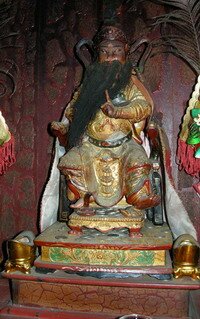
You will see the image of the great general Guan Yu frequently in Chinese dominated countries. Guan, who played a significant role in the civil war the Three Kingdoms period (which ended with the collapse of the Han Dynasty and the establishment of the state of Shu Han), was deified as early as the Sui Dynasty. He is still worshipped by many Chinese people today, especially in southern China, Taiwan, and Hong Kong and their descendants overseas.[1]

He is usually depicted as a red-faced warrior with a long lush beard and holding Guan dao and popularly worshipped today among the Chinese people. In the Western World he is known as Taoist God of War. In Buddhist tradition he is worshiped as a bodhisattva and  in Taoism as a guardian deity:
Guan Yu-the great general of heaven, patron of policemen, soldiers and protectors of law, seen as the epitome of loyalty and righteosness. He was a mortal man living in the times of the 3 Kingdoms, a much romanticized period of history in China, where he was an important figure in the civil war to dispose the Han dynasty. He is portrayed as a powerful warrior with a red face (the color, not rouge) and black hair and a long beard. Though many modern artists have taken the red face away to show that he was born a mortal. He carried a guando, which is similar to a halberd, called the Green Dragon Cresent Blade (though I have also seen it called the Black Dragon Blade,) and wears a green robe with his body armor. After his defeat and death, he was apotheisized into a god. He is a Folk god, a Taoist god, a Boddhisatva, and a Confucian ideal of the virtues of honor and loyalty. He is a very popular deity, and there is a lot of information available about him, so look him up.
Guan Yu holding Guan Dao
Chinese guardian lions
Known as "Foo Dogs" in the Western world were common presentations of lions in the pre-modern China. Chinese artists of those times, who have never seen a lion with their own eyes, depicted this creature based on the narratives of travelling monks who have seen these creatures in the west and used a lot of imagination. They are believed to have powerful mythic protective benefits and still can be seen at the entrance of many Chinese buildings and businesses. The lions are always in pairs, one of them is male and the other one is female. The male lion usually presses his paw onto a sphere representing the world and the female lion is usually depicted playing with a lion cub.

The male guardian lion in front of Ngee Ann City in Singapore. The female can be seen  behind.

[1] - Guan Yu