Friday, March 16, 2012

Cheapest and Most Expensive Cities to visit for tourists


According to the UBS Price and Earning Index for 2011, Singapore has climbed from 24th place to the 10th place in the list of most expensive destination for a tourist to visit in just 2 years. Currently, Singapore hotels are the most expensive in Asia with an average price of 239 Singapore Dollars or 145 Euros per night. On the other hand, the capital city of the neigbouring Malaysia, Kuala Lumpur, is the seventh cheapest place to visit. Actually,Kuala Lumpur offers some of the world's cheapest 5-star hotels, cheap and great shopping and even better food and increasing numbers of travellers are discovering this little gem of a city according to wikitravel and my experience with this small but nice city.

Oslo of Norway, where a bottled water will cost 6 US Dollars or 7.5 Singapore Dollars, is the most expensive since 2006 according to the same study while Mumbai of India is the cheapest destination.


Cheapest Cities To Visit 
City Country Cost of a typical basket of goods
1 Mumbai India US$40.20 ($50.90)
2 Manila Philippines US$45.30 ($57.40)
3 Delhi India US$49 ($62.10)
4 Nairobi Kenya US$50.40 ($63.80)
5 Cairo Egypt US$50.50 ($63.95)
6 Buenos Aires Argentina US$52.40 ($66.30)
7 Kuala Lumpur Malaysia US$52.90 ($67)
8 Bucharest Romania US$56 ($70.90)
9 Lima Peru US$56.80 ($71.90)
10 Mexico City Mexico US$58.60 ($74.20)
11 Sofia Bulgaria US$58.90 ($74.60)
12 Manama Bahrain US$59.50 ($75.30)
13 Kiev Ukraine US$59.90 ($75.80)
14 Vilnius Lithuania US$60.90 ($77.10)
15 Santiago Chile US$61.90 ($78.30)

Most Expensive Cities To Visit
City Country Cost of a typical basket of goods
1 Oslo Norway US$139.10 ($176.10)
2 Zurich Switzerland US$135 ($170.90)
3 Geneva Switzerland US$133.10 ($168.50)
4 Copenhagen Denmark US$118.40 ($149.90)
5 Stockholm Sweden US$117.50 ($148.80)
6 Tokyo Japan US$112.60 ($142.60)
7 Sydney Australia US$107.70 ($136.40)
8 Helsinki Finland US$103.50 ($131.10)
9 Toronto Canada US$102.80 ($130.10)
10 Singapore Singapore US$102.40 ($129.60)
11 Vienna Austria US$102 ($129.10)
12 Paris France US$100.90 ($127.75)
13 Luxembourg Luxembourg US$100.10 ($126.70)
14 New York City US US$100 ($126.60)
15 London UK US$99.80 ($126.30)


Diabetes in Singapore


Type 2 diabetes is a complex disease that involves high levels of blood sugar that cannot be processed by the hormone insulin.[1] Diet, obesity and lack of exercise are cited as causes of diabetes as well as heredity.  According to a newly published data from the International Diabetes Federation (IDF) showed that some 285 million people live with diabetes today as compared to an estimated 30 million people in 1985. This is over a seven-fold increase in just over 20 years and it will be close to 440 million by 2030.[2]

And unfortunately,  Singapore has one of the highest rates of diabetes in the developed world[3]. Actually situation is getting worse and diabetes is currently the 7th most common cause of death in Singapore:

"Type 2 Diabetes constituted less than 5 per cent of all childhood diabetes 15 years ago. Today, it accounts for one-third of all childhood diabetes in Singapore. Half of all adolescent-onset diabetes is now Type 2 and the prevalence of childhood obesity is rising in Singapore as well, with 12.7 per cent of children being overweight in 2006 compared to 10.2 per cent in 1999. Diabetes is a factor in about 9 per cent of all deaths in Singapore, and is the seventh most common cause of death locally."

Today, 11% of Singaporean adults have diabetes[4]. And a recent study gives some hint that Asian diet style, particularly excessive consumption of excessive rice in Asian diet, may have been the reason we have high number of diabetes in Singapore:

"What we've found is white rice is likely to increase the risk of Type 2 diabetes, especially at high consumption levels such as in Asian populations," Qi Sun of the Harvard School of Public Health told AFP.

"But at the same time people should pay close attention to the other things they eat. It's very important to address not just a single food but the whole pattern of consumption." [1]

The problem may not only be the high level of rice consumption. Food in Singapore, especially the ones in popular hawker centers and food courts, also tend to be very oily. But if the rice is the cause, there is a way to decrease the risk: brown rice.

White rice we use dominantly in our diet is a processed food and as many processed foods it becomes a health problem if eaten a lot. Machines in rice mills produce white rice's polished look by hulling and milling, leaving a grain that is predominantly starch. Brown rice, by contrast, has more fibre, magnesium and vitamins, and a lower "glycaemic index," a measurement of sugar content, than white rice.[1]

And unfortunately, it seems like things will get worse:


By 2050, Singapore may have as many as one million diabetics. Every one in two people, by age 70, will be diabetic - up from one in three today. Of the adult population, 15 per cent will suffer from the disease, compared with 11.3 per cent now. 
And because people here are not just getting older, but also fatter, obesity is likely to push up the risks of diabetes, which in turn raises the risk of stroke, heart and kidney failure, and blindness.[4]

[1] - White rice link seen with Type 2 diabetes, says study
[2] - Tackling The Diabetes Epidemic
[2] - Fighting diabetes and other metabolic disease in Singapore
[3] - Health Minister Mr Gan Kim Yong at World Diabetes Day 2011, 
[4] - 1m diabetics by 2050 as Singaporeans get older, fatter

Thursday, March 15, 2012

Banks are hiring more and more locals in Singapore and Hong Kong compared to expats


A local talent pool getting more experienced and mature every year, expats getting more and more expensive and governments push to encourage local hiring is having their collective effects on bank hirings as more and more banks are hiring locals while expat hirings are slumping according to efinancialcareers.com:
"Localising their workforces has long been a priority for global and regional firms in Singapore and Hong Kong. But the push to hire local candidates is gaining even stronger momentum this year. 
Jansen Gwee, general manager, banking and financial services, InterQuest Asia, Singapore, says the candidate pool in Asia has matured considerably. While firms may have typically appointed foreign bankers to lead teams five to ten years ago, this has since changed, with Singaporean candidates having gained experience and better honed their business skills."
 In Singapore, as well as Hong Kong, expensive expats benefits increasingly look "not worthy" even after great reductions in the size and durations of expat packages:
"Although cushy packages for overseas staff aren’t too popular these days, some firms still cover housing expenses for six to 12 months. Gwee says: “If you go down to the dollars and cents, this can be about 20 per cent more. In addition, expat compensation is generally 20 to 25 per cent higher because salary scales may be larger in their respective economies.” All this adds up as firms keep a closer eye on costs."
For majority of the expats in banking and financial services industry in Singapore and Hong Kong, these destinations are temporary experience hubs before going back to West again which creates continuity issues. Increased requirement of Asian language skills, particularly Chinese, also gives an edge to local banking talents in Singapore and Hong Kong over their expat competitors. Majority of Singapore and Hong Kong population are Chinese with Mandarin skills even if it is not their mother dialect.

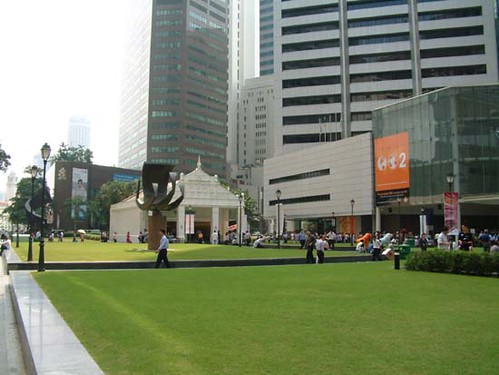
Singapore Raffles Square 
According to the article, what all these mean that expat hires are significantly down in the current climate, 30 per cent decrease year-on-year:

“Most of these are typically for cross-border M&A roles and for private banking positions servicing specific foreign markets. 
Aldrich is also seeing some banks move senior people from the US, Europe and the Middle East into Asia Pacific. It’s an alternative way of using internal talent that could be retrenched, scaling up businesses or providing career growth. He anticipates “a continued desire to localise positions wherever possible”.

New Singapore private property sales and unsold units up, resale sales down in February 2012


Singapore property market is becoming a text book example of a cheap credit fuelled bubble party as February 2012 new property sales in February 2012 surged to a record 3,138 units. 725 of these were Executive Condominiums, which was the highest monthly sales for ECs since October 2010 and most probably fuelled by the 6 fold increase in second-timer quotes last month. Rest was new private properties, 2413 units, and this number was also the second only to the 2772 record of July 2009.

The main demand driver is the low mortgage names, which is constantly fuelled by central bank money printing machines of USA, China and recently Europe. Artificially low mortgage and ultra-high rental rates are making even very high priced properties temporarily “affordable” by creating a positive cash flow of rental income minus mortgage payments. The toxic low interest on deposit – high inflation environment also push people to park money in property.

Developers are racing to launch more and more project and close sales by attractive pricing which drove the sales up but also fuelled the already high number of launched but unsold units to all time high of 7586.
This numbers also fuelled the speculations that Singapore government would step in with another rounds of property cooling measures in Singapore. Singapore government has just introduced a new property cooling measure in December 2011 targeting foreigners and looking like to prevent a damaging flood of printed foreign money into Singapore but that money looks like flowing into Singapore anyway as mortgages taken by Singaporeans and Singapore PRs to buy public and private property. It increasingly looks like the only way to cool the property market is  to target the low interest rates directly, but since Singapore Central Bank, Monetary Authority of Singapore (MAS), do not use interest rates as policy tool, I do not think anyone is expecting a measure of this kind.

Singapore new property sales per month from Sep-2011 to February 2012


February 2012’s top selling projects were;

  • Parc with 380 units and average price of 994 $psf,
  • Guillemard Edge with 275 units and average price of 1215 $psf,
  • Watertown with 174 units and average price of 1260 $psf,
  • Casa Camblo with 155 units and average price of 1393 $psf.

Last month, developers launched 3,600 units (35% more than January 2012 figures) and according to Mr. Lee Sze Teck from Dennis Wee Group the strong buying interest was probably sparked by well-located projects and attractive pricing by developers. But the story was completely different in the secondary market where there seems to be a “stalemate” – a mismatch of price expectations between sellers and buyers.

Sellers, having a comfortable and long lasting holding power thanks to current positive cash-flow of rent minus mortgage payment, are probably insisting on unrealistic high prices while buyers are not “buying in” thanks to a lot of choices they have currently. Secondary private home market, which was trending down since last April, recorded only 376 caveats in January 2012, a dive from both 1012 units of December 2011 and April 2011 peak of 2,002 units.

Tuesday, March 13, 2012

Singapore Hotels are most expensive in Asia


Yesterday, I was in a conference organized by a Business Intelligence provider and a guy was talking about the refinement in searching for the information in Google. He said if you look for hotels in Singapore, you will get 3 million+ results. To have a more meaningful result set, you need to add more information to your search like searching for “business hotel”. This will return a little less than 1 million results. Refine more and you will have more useful set. For example if you search “cheap business hotel” you will get much less results: “You get 200K results. But of course none of them is useful since there is nothing like a cheap hotel in Singapore!”

He was joking but he has a point: hotel rooms are very expensive in Singapore. According to hotels.com, hotel rooms in Singapore are the most expensive in Asia thanks to increasing Singapore Dollar and booming tourism sector. The prices actually are so high that an average hotel room in Singapore costs 239 Singapore Dollars (145 Euros) which is ahead of countries such as the Netherlands (S$238), the United Arab Emirates (S$234), Australia (S$218) and Canada (S$213).

This result is based on the The Hotel Price Index (HPI) compiled by Hotels.com. The Hotels.com® Hotel Price Index™ is a regular survey of hotel prices in major city destinations across the world. The HPI tracks the real prices paid per room by Hotels.com customers around the world using a weighted average based on the number of rooms sold in each of the markets in which Hotels.com operates. Approximately 142,000 properties in more than 19,800 global locations make up the sample set of hotels from which prices are taken:


Marina Bay Sands Hotel SkyPark Infinity Pool
Singapore hotels are most expensive in Asia.
Here Marina Bay Sands Hotel SkyPark is seen.
The same survey also shows that Asia is getting more popular among Americans by every passing year. Hong Kong is the the seventh most visited international city by Americans in 2011.

“A growing business, cultural and culinary hotspot, Singapore rose as one of the most expensive Asian cities, seeing a year-over-year average daily rate increase of 18 percent. Travelers looking for travel deals to Asia should look at Phnom Penh, Cambodia and Chiang Mai, Thailand before demand for these locations rises and prices increase.”

Saturday, March 10, 2012

Singapore workers expect gloomy job prospects in 2012


It is the job hunting season and the best time to find a job in Singapore but this year employees look more pessimistic about the prospects as well as salary increment. 54 per cent of about 1,700 workers polled by Singapore based Berkley Recruitment Group Asia have thought that there are enough or lots of job opportunities down from 80 per cent of last year and lowest since 2010. This is due to the uncertainty about the global economy and the gloomy job outlook in financial services sector.[1]

Salary increment expectations are also creeping and only 12 per cent of the respondents thought that they would get 10 per cent or more salary increase in a year of near 6 per cent inflation. This is independent of increment by a new job or existing job. On the other hand 23 per cent have already received or expecting a salary freeze this year. This number was 16 per cent last year.

Singapore employees are the gloomiest in South East Asia but they are more optimistic than the ones in USA (45% thinks there are at least enough jobs) and Britain (44% thinks there are at least enough jobs) and France (42% thinks there are at least enough jobs).

Just a year ago, Singapore job market was employee's market where there were plenty of jobs for the people in Singapore. But now in 2012 job hunting season, Singapore job market is gradually becoming an employer's market. Hiring in the services sector is quite strong, which is worrying since service sector jobs are usually low paying unproductive jobs where each employee is easily replaceable at least employer's usually think like that.

For the star employers in Singapore, agressive hiring may be also over:

"Berkley Chief Executive Steve Greenwood said he had not seen bulk hiring in banks nor huge investments in new sites or facilities from the pharmaceutical sector."

On the other hand, same group has recently reported that job prospects are still bright for professionals and execs in Singapore:

"PROFESSIONALS and executives in Singapore have been on a roll, with many having multiple job offers thrown at them. And the pay and career prospects of these staff up the job ladder - especially those in
the pharmaceutical and life sciences, information technology and commercial sectors - have been given an extra boost in the war for talent in a hot job market that's getting hotter.

Compared to a global average of 43 per cent, nearly two in three - 66 per cent - of  the 2,706 professionals and executives polled here in the final three months of 2010 were approached by three or more headhunters in the past year.

Some 82 per cent, up from 75 per cent in the third quarter, saw a pay increase coming in 2011, according to the poll taken by the Berkley Recruitment Group which has offices in Singapore and Europe.

Some 27 per cent of those polled, against 19 per cent in the previous quarter and a  global average of 13 per cent, were looking to a raise of more than 10 per cent. Twenty-seven per cent of the professionals and executives felt the chances for a promotion had improved in the past 12 months. The global average was 23 per cent. The quarterly poll was taken to gauge the jobs market sentiments of professionals and
executives, which clearly have grown more upbeat.

'Confidence in the Singapore jobs market continues to soar at the professional and  executive level,' says Steve Greenwood, Berkley's chief executive in Asia."
Source: Bright Job Prospects For Professionals, Exec

[1] The Straits Times, Singapore workers fear though times

Wednesday, March 7, 2012

Private banking in Singapore


For banking clients with sizable assets, high net worth individuals (HNWI), there is a special kind of banking where the customer service is more personalized compared to the retail banking experience for the man on the street: private banking. And as the wealth in Asia is increasing every year, Asian private banking is having more market share in Singapore. Private Banking in Asia and Singapore is recently hot; according to ABN AMRO Bank NV-Private Banking, Asia is the fastest growing private banking market in the world and home to 3.3 million high net worth individuals with assets totalling US$10.8 trillion.

Below is a list of private banks in Singapore:
  1. ABN AMRO Bank NV-Private Banking. ABN AMRO is the oldest bank in Singapore and was voted one of the Top 10 Best Global Private Banks in Asia in 2011 in Asiamoney Private Banking Poll.
  2. ANZ Private Bank has presence in 5 of Asia's key markets - Singapore, Hong Kong, Taiwan, Indonesia and UAE. They serve Singapore market from Ocean Financial Centre (ANZ is the anchor tenant of this newly completed building).

  3. Bank Julius Baer & Co Ltd. With over 40 locations, Julius Baer's Singapore office is the biggest outside of Zurich.

  4. Bank of Singapore Ltd. is a wholly-owned private banking subsidiary of OCBC Bank which is formed by the January 2010 acquisition of ING Asia Private Bank (IAPB) by OCBC Bank, one of Asia's leading financial services institutions. The combined private banking businesses of IAPB and OCBC was subsequently named Bank of Singapore.

  5. Barclays Bank PLC

  6. BNP Paribas Wealth Management

  7. BSI Bank Ltd.

  8. Citi Private Bank

  9. Coutts & Co Ltd.

  10. Credit Agricole (Suisse) SA
  11. Credit Suisse AG

  12. DBS Private Bank

  13. Deutsche Bank Private Wealth Management

  14. HSBC Private Bank (Suisse) SA

  15. Societe Generale Private Banking

  16. Standard Chartered Private Bank

  17. UOB Private Banking

  18. UBS Wealth Management Singapore
Advertisement: 
Private Banking Analytics by KMS

Singapore job aggregator : indeed


It is once again the job hunting season in Singapore. Festive season is up, 13th month and performance bonuses are paid and people are ready to look for greener pastures. Singapore companies offer no meaningful incentive to keep on working in the same place for years and the only way to truly have an increment ones salary is to find another job. So everyone here looks like transient workers locals or foreigners. So people will also collect their bonuses and jump to other positions and the companies will fill in the empty spaces (I am amused when people are surprised with persistent and creeping productivity in Singapore where there is a mass job hopping season!).

Anyway, since this is the best time to look for a job in Singapore, you also need to know the best places to look for one. In my opinion, job aggregators are the best places to look for a job since they collect job advertisements from different sources, including individual company recruitment sites, to a single place for you.   Here are two Singapore job aggregators;


  • It is very surprising to see that Indeed.com, a metasearch engine for job listings launched in November 2004, is still relatively unknown in Singapore. Indeed is currently available in 53 countries including Singapore and in 2010, it has surpassed Monster.com to become the most visited job site in the United States. Indeeds Singapore job search engine is here at www.indeed.com.sg. Simply enter what you want and in which town or estate and indeed will aggregate many jobs from different sites to you. It also has a  pay-per-click job advertising network which will be displayed as sponsored jobs in the search results.

  • careerjet.sg, is another aggregator. The job offerings themselves are not hosted by Careerjet and users are always redirected to the original job listing. Essentially, Careerjet acts as traffic driver to those sites. Careerjet's job search engine network encompasses over 50 countries, featuring separate interfaces that are translated into 20 languages.

Sunday, March 4, 2012

More Build-to-Order (BTO) flats for second-timers


Khaw Boon Wan, Minister of National Development, has recently announced in Budget 2012 that more flats will be allocated to second-timers starting from March 2012 sales exercise. Depending on the location and HDB unit type, up to 30 per cent of new homes will be set aside just for second timers:

"Minister for National Development Khaw Boon Wan announced in Parliament today several new housing measures to provide more housing options for second-timers:
a) Allocation of Build-to-Order (BTO) flat supply in non-mature estates to triple from 5% to 15% – to provide second-timers better access to affordable new flats
b) Allocation of Executive Condominiums (ECs) to increase 6-fold from 5% to 30% – to help second-timers realize their upgrading aspirations"
Source : Offering Second-Timers More Housing Options

Second timers are those prospective buyers who have already used public housing subsidy from the Government before. Mr. Khaw has been signaling that once the application rates for first timers stabilize, HDB will increase the number of units allocated for second timers. Back in January 2012, in his blog post named An Auspicious Start, he has mentioned that this condition is met:

"The first-timer application rate is currently a comfortable 1.5.  Not surprising.  This is similar to the rate of 1.6 in the November BTO.  Both are good rates; they mean that practically all will get a chance to choose a unit.

Our goal to help young couples get their first homes is coming true. We can now move on to better help the second-timers. Their application rate is currently 23.9, compared to 25.9 in the November BTO.

I hope to be able to announce some changes to BTO balloting rules for the next BTO launch in March."

According to HDB, application rates for first timers have stabilized to less than 2 applicants per unit in the recent launches. This means that almost all first time applicants can grap an HDB unit when they apply.

With the new rules, the quote for second timers in non-mature HDB estates is tripled to 15% from 5%. 70% of new HDB's released are from non-mature estates. The quote for mature estates and sales of balance flats (SBF) has not changed yet.

An important change is in Executive Condominiums (ECs) where the quote is increased six times to 30% which is effective immediately.


New HDB Second-Timer Quotes
Build-to-Order (BTO) Executive Condominium (EC)
Mature Estates Non-mature estate Sales Of Balance Flats 
Previous Quote 5% 5% 5% 5%
Revised Quote 15% 5% 5% 30%
Effective March 2012 BTO Launch March 2012 BTO Launch March 2012 BTO Launch Immediate


Will these quote changes for second-time buyers effect first-time buyers. HDB says no:

"No. The large BTO flat supply has cleared much of the backlog of first-timers waiting to buy a flat and application rates have since stabilised. In addition, HDB will be releasing another 25,000 BTO flats this year. As such, we are looking to help second-timers, while remaining confident that the needs of first-timers will be met." Source : HDB Q&A

Saturday, March 3, 2012

1966 color photo of Raffles Place


I have seen this rare gem, a color photo of Raffles Place taken in 1966/67, in mrbrown.com. Raffles Place can easily be considered as the place where Singapore story started.  The founder of modern Singapore, Sir Stamford Raffles, wanted Singapore to become a "great commercial emporium and at the heart of this dream was Raffles Place.[1] The place was first named Commercial Square but renamed to Raffles Place back in 1850s.

Unfortuntely, the place is currently not as beautiful as it was back in 1966. All the buildings you see in this photo are demolished and Raffles Place is now a sterile, ugly, and a soul-less place squeezed with skyscrapers (see photo below).

Downtown Singapore
Raffles Place 1966/67 - Source : Flickr
SNAP: Singapore National Album of Pictures comments in Flickr gives a brief description of the buildings:

"The old classical Chartered Bank building featured here was designed by Swan & Maclaren. It was replaced in 1982 by a 44-storey rhombic-shaped building now renamed as 6 Battery Road.

The United Overseas Bank [former United Chinese Bank] stood at the corner of Bonham and Chulia street. The old building in the photo was demolished and the construction of a new one started in 1970 and was ready in 1974.

On the John Little site today is Shell Towers, built in 1982. In 1965, the open space in the foreground was excavated to provide for a underground carpark accommodating 250 cars. Above it [as seen in the photo] was a landscaped garden; with two ornamental fountains and 42 lamps that lit the garden by night.
Today, the underground carpark has been converted to the Raffles Place interchange for the MRT [Mass Rapid Transit] trains."

Raffles Place 2012